Low-Tech vs High-Tech Assistive Devices: Why Simpler Is Often Better
The assistive technology field divides devices along a spectrum from mainstream to commercially available assistive to custom-made, and separately along a scale from low technology to high technology. Knowing where a device sits on both axes helps families make smarter purchases, because the marketing pressure is almost always toward the most complex, most expensive option — and that is very often the wrong choice.
Cette article est actuellement disponible en anglais. Nous preparons la traduction en Francais.
15 avr. 20264 min
Sur cette page
What "low tech" actually means
Low-technology devices are simple in construction, inexpensive, and usually do not require a power source or programming. Think mouth sticks, adapted utensils, reachers, key guards, pencil grips, raised toilet seats, dressing sticks, and non-slip mats. They are easy to acquire, easy to replace, almost impossible to break in ways that matter, and easy to explain to the user. Cook and Polgar note that low-tech devices tend to be more acceptable to users and are less likely to be used incorrectly — precisely because their simplicity removes friction at every step.
What "high tech" means
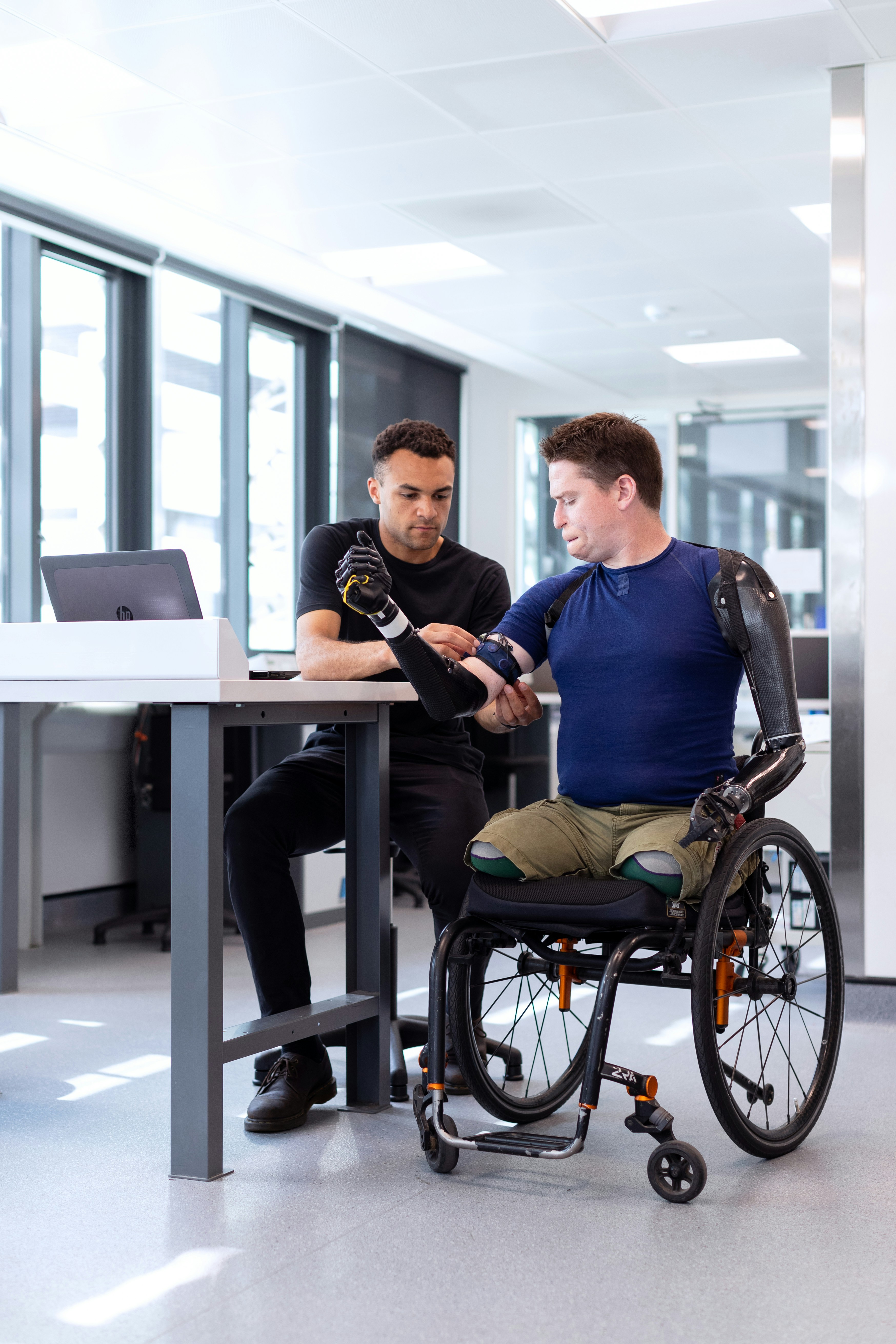
High-technology devices are more complex: they may be electrically powered, feature-driven, programmable, or multifunctional. Powered wheelchairs, communication devices, environmental control units, robotic feeders, hearing aids with app-based tuning, and smart-home integration systems all live here. They can be extraordinary — sometimes life-changing — but they are also more expensive, harder to acquire, and more demanding to learn. A failed high-tech purchase is a bigger loss than a failed low-tech one.
The temptation to over-specify
Families, well-meaning donors, and sometimes clinicians tend to default to higher-tech solutions because they seem more "serious" or more "modern." A caregiver who donates a sophisticated speech-generating device to a non-speaking child is doing something generous, but if the child's real barrier is learning symbol language and there is no trained clinician or daily practice plan, the device will sit unused. A simple laminated picture board may produce ten times the communication in the same week. The right answer is whichever tool actually gets used, not whichever one has the most features.
When high tech is the right answer
Higher-technology devices earn their price tag when the activity genuinely requires them. A user with no functional speech and strong cognitive ability needs a real communication device, not a picture board. A person with a spinal cord injury at a high level needs a powered chair with tilt and recline, not a manual one. A child with progressive muscular dystrophy needs equipment that grows with them and adapts to decreasing strength. In those cases, the complexity is the point.
A practical rule of thumb
Start with the simplest device that plausibly solves the problem. Use it for long enough to see whether it works. If it does, you are done. If it does not, you have real data — specific friction points — to justify stepping up in complexity. This is the opposite of how most purchases happen, and it is why most closets contain expensive, barely used equipment. Stepping up from simple to complex is cheap and informative. Starting at complex and scaling back is expensive and demoralizing.
The training difference
Low-tech devices usually need ten minutes of demonstration. High-tech devices need structured training, written reference material, and ongoing follow-up. Budget both money and calendar time for the training, not just the purchase. A rule many clinicians use: if you cannot commit to the training, buy the lower-tech option.
Key takeaways
Simplicity wins more often than marketing suggests. Start low-tech, escalate only when the simple option has proved insufficient, and always match the complexity of the device to the training and support the household can realistically provide. That discipline saves money, prevents abandonment, and usually delivers the best outcomes.
Rehabilitation professionals have long known that selecting the technically correct device is not enough. Studies consistently show that approximately 30% of assistive devices are abandoned within the first year of use. The devices usually work. The problem is almost never the engineering. Marcia Scherer's Matching Person and Technology model — one of the most studied frameworks in the field — was built specifically to address the factors that functional assessments miss: the personal, motivational, and psychosocial ones.
When someone's mobility or function changes — whether from a new diagnosis, a hospital discharge, or the slow arithmetic of aging — the home often needs to change with them. The question families ask is nearly always the same: where do we even start? The answer is to go small before you go big, because most families over-build and under-train. A few correct purchases and a handful of adjustments usually cover eighty percent of the real problem.